

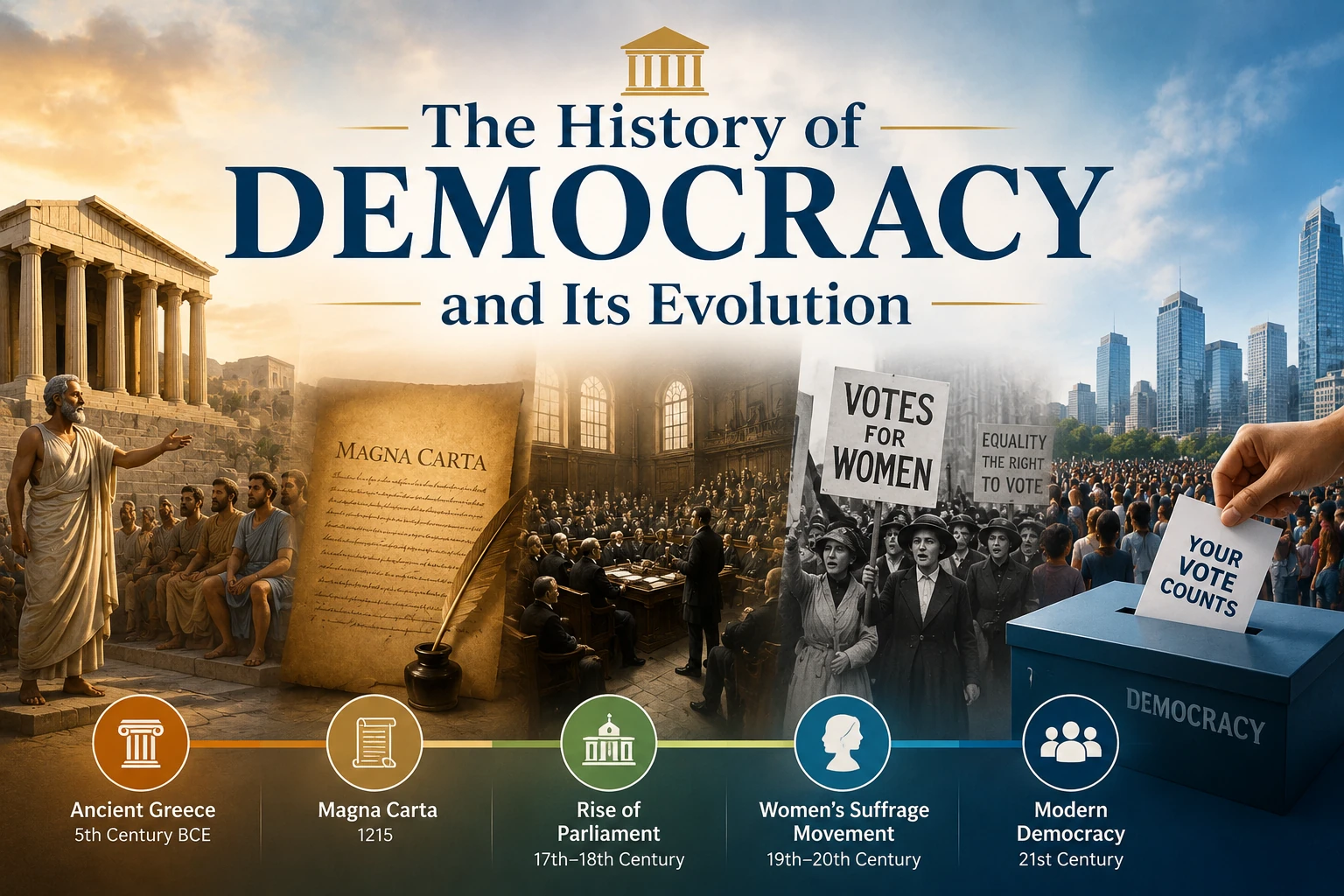
Democracy is one of the most influential political ideas in human history. The basic concept is that people should have a role in determining how they are governed. However, democracy has never been a single fixed system. It has evolved through centuries of political experimentation, social movements, revolutions, reforms, and debates about representation and rights.
Understanding the history of democracy helps explain how modern political systems developed and why democratic institutions continue to change.
Democracy in Ancient Greece
The word democracy comes from ancient Greek concepts associated with rule by the people. One of the earliest well-known democratic systems developed in Athens around the fifth century BCE.
Athenian democracy was based largely on direct participation. Eligible citizens could participate in assemblies and vote on certain decisions.
However, this system was far from modern universal democracy. Women, enslaved people, and many others were excluded from political participation. Nevertheless, the Athenian experiment established important ideas about citizen participation and public decision-making.
Republican Ideas in Rome
The Roman Republic developed another important tradition of political governance. Rome combined elected officials, assemblies, and other institutions rather than relying on direct democracy alone.
Roman political ideas influenced later thinkers and political systems, particularly concepts involving representative government, civic duties, institutions, and legal structures.
Although Roman political participation was also limited, its institutional legacy became significant in the development of later republican thought.
Democracy and Political Thought
During the medieval and early modern periods, political power was often concentrated in monarchies, aristocracies, and other hierarchical institutions. Nevertheless, ideas about representation, law, rights, and limits on government continued to develop.
Political philosophers increasingly debated questions about individual freedom, political authority, and the relationship between citizens and governments.
These ideas eventually contributed to major political transformations.
Democratic Revolutions
The American and French Revolutions were important milestones in the development of modern democratic and constitutional ideas.
The American Revolution contributed to the development of a constitutional republic based on elected representation and divided governmental powers. The French Revolution challenged traditional monarchy and promoted ideas involving citizenship and political equality.
Neither revolution immediately created fully inclusive democracies, but both had lasting influence on political thought and institutions.
Expansion of Voting Rights
Modern democracy developed through a long process of expanding political participation. In many societies, voting rights were initially restricted by property ownership, wealth, gender, race, or social status.
Over time, political movements campaigned for broader suffrage. Women gained voting rights in many countries during the late 19th and 20th centuries, while other groups fought against legal and social barriers to political participation.
The expansion of voting rights helped move democracy toward the broader principle of political equality.
Representative Democracy
As populations grew, direct participation in every government decision became impractical in many societies. Representative democracy therefore became increasingly important.
Citizens elect representatives who make laws and decisions on their behalf. Elections, legislatures, political parties, courts, constitutions, and independent institutions can all play important roles in representative systems.
This structure allows large populations to participate in government while maintaining functioning political institutions.
The Role of Political Parties
Political parties became important in organizing voters and presenting different policy approaches. They help recruit candidates, develop platforms, communicate political ideas, and coordinate legislative activity.
Parties can make political choices easier for voters to understand, although competition between parties can also produce polarization and political conflict.
Democracy in the Modern Era
Today, democratic systems vary significantly. Some use parliamentary governments, while others use presidential or semi-presidential structures. Constitutional arrangements, electoral systems, and institutional checks also differ.
Modern democracies generally emphasize principles such as elections, political participation, legal equality, civil liberties, and government accountability, although their implementation varies across countries.
Challenges Facing Democracy
Democracy continues to face challenges, including political polarization, misinformation, declining trust in institutions, corruption, unequal political influence, and barriers to participation.
Digital technology has created new opportunities for civic engagement but has also made it easier for misleading information to spread rapidly.
Strong institutions, informed citizens, independent journalism, transparent elections, and respect for political rights can help democratic systems address these challenges.
The Continuing Evolution of Democracy
The history of democracy shows that political systems are constantly evolving. From ancient experiments in citizen participation to modern representative governments, democracy has been shaped by debates over who should have political power and how governments should be held accountable.
Its future will depend on how societies respond to technological change, social inequality, political disagreement, and changing expectations about representation.
Democracy is therefore not simply a historical achievement. It is an ongoing process that requires participation, institutions, public debate, and continued efforts to protect political rights and accountable government.